
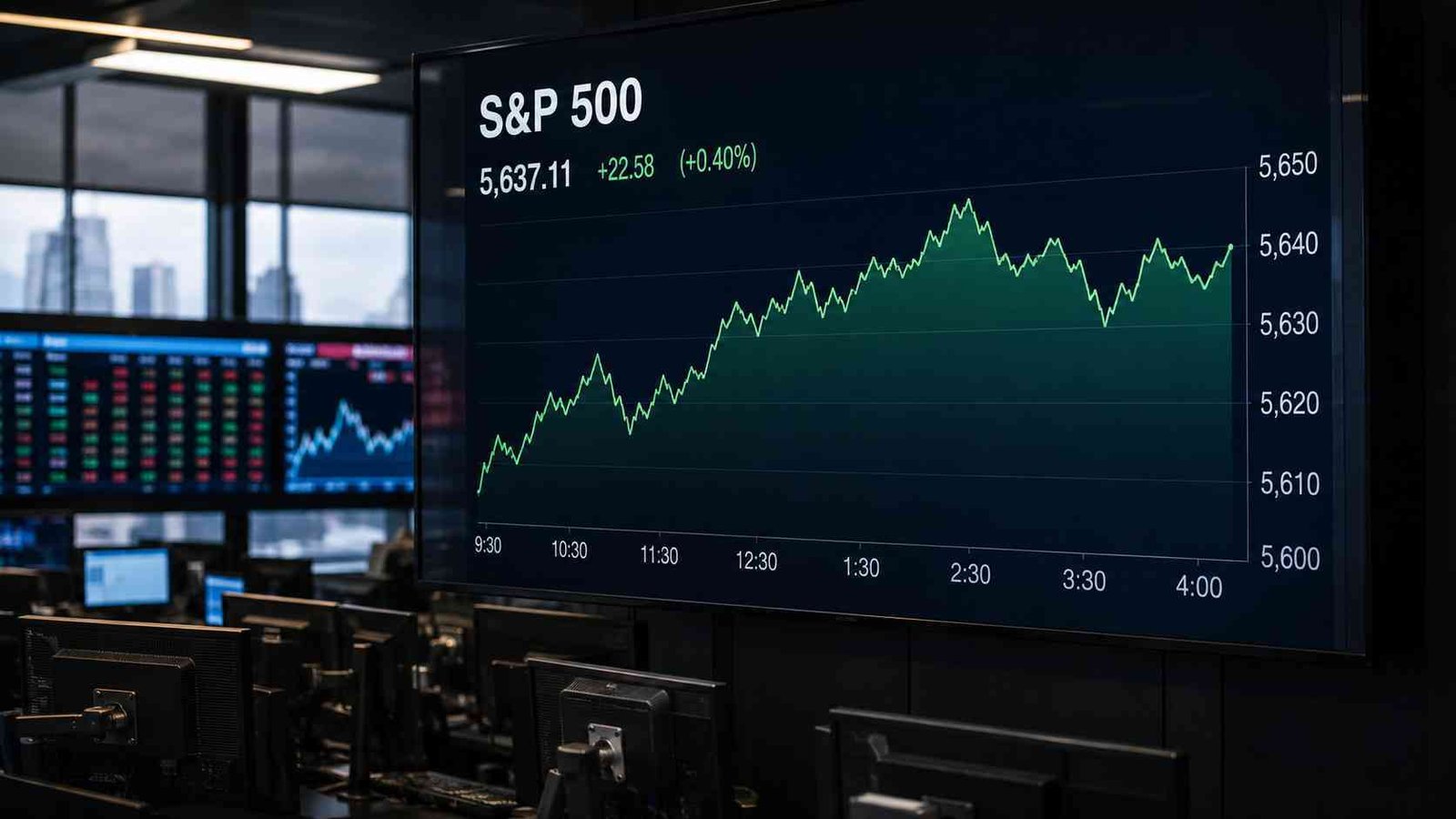
S&P 500: How the Index Works, Is Calculated and Weighted

The S&P 500 tracks a broad group of large-cap U.S. companies and serves as a major benchmark for the American stock market.
It is not simply a list of 500 companies, though. The index gives different companies different levels of influence, largely because its weighting system is based on float-adjusted market capitalization.
That structure affects almost everything about the index, from how daily movements are calculated to how individual companies influence its performance.
This guide explains how the S&P 500 works, how companies qualify for inclusion, how the index is calculated, what its sectors represent, and what investors should understand about its returns and risks.
What Is the S&P 500?
The S&P 500 is a stock market index designed to measure the performance of large-cap U.S. companies. It is widely used as a benchmark for this segment of the American equity market.
An index is not a company or an investment product. Instead, it measures the combined performance of a selected group of securities.
Companies enter the S&P 500 after meeting the relevant eligibility requirements and being selected for inclusion. Their stock movements then affect the index according to their individual weights.
The name does not always mean there are exactly 500 constituents. Certain companies can have more than one share class represented in the index.
Company size also matters. A larger company generally receives a larger weight because the S&P 500 uses float-adjusted market capitalization.
As a result, two stocks can rise by the same percentage while having very different effects on the index.
For this reason, the S&P 500 is better understood as a benchmark for large-cap U.S. equities than as a simple list of 500 stocks.
How Does the S&P 500 Work?
Each company contributes to the index according to its weight. That weight is based on float-adjusted market capitalization.
In simple terms, the calculation considers a company’s market value while accounting for the shares available for public investment.
Public float matters because not every outstanding share is necessarily available for ordinary public trading. Certain shares held by controlling interests or other holders may not be included in the float calculation.
A company with a larger float-adjusted market value generally receives a larger weight. Its stock price can therefore have a stronger effect on the index than the price of a smaller constituent.
This can produce results that seem surprising at first.
The S&P 500 can rise even when many individual stocks are falling. Strong gains among heavily weighted companies may outweigh declines elsewhere.
The opposite can happen too. Weak performance among the largest companies can pressure the index even when many smaller stocks are gaining.
So, the S&P 500 is not simply an average of its constituent stock prices. Its weighting system gives greater influence to companies with larger investable market values.
How Is the S&P 500 Calculated?
The S&P 500 calculates its index level using the float-adjusted market value of its constituents and an index divisor.
At a basic level, the combined market value is divided by the divisor to produce the published index level.
The divisor has a specific job. It helps maintain continuity when changes to the index would otherwise create an artificial rise or fall.
Imagine one company leaving the index and another taking its place. The index should not suddenly move just because its list of constituents changed.
An adjustment to the divisor helps prevent that distortion. Similar adjustments can be made for certain corporate actions.
This is why the S&P 500 is more complicated than a simple average. Its calculation is designed to reflect changes in the market value of its constituents while keeping the index consistent when structural changes occur.
The weighting system remains important throughout the calculation. Companies with larger float-adjusted market values have greater representation, so their price movements carry more weight.
How Are Companies Selected for the S&P 500?
Being a large U.S. company does not automatically put a business in the S&P 500.
A company must first meet the index’s eligibility requirements. These include factors such as U.S. company status, market capitalization, public float, liquidity, and financial viability.
The methodology also includes a profitability requirement. A company must have positive earnings in the most recent quarter as well as positive earnings when the most recent four quarters are combined.
These requirements help keep the index focused on large, investable U.S. companies with the financial characteristics required by its methodology.
Meeting the eligibility requirements does not guarantee inclusion.
The S&P 500 Index Committee selects companies from the eligible universe while considering the overall representation of the index.
That distinction matters. The S&P 500 is not simply a computer-generated ranking of the biggest American companies.
Market size plays a major role, but eligibility and selection are separate steps.
Companies can also leave the index. Mergers, acquisitions, bankruptcies, delistings, and other major corporate events can affect whether a company remains eligible.
This allows the index to change as the large-cap U.S. equity market changes.
How Often Does the S&P 500 Change?
The S&P 500 is not a permanent list of companies. Its constituents can change as businesses grow, decline, merge, get acquired, or no longer meet the requirements for inclusion.
Regular rebalancing takes place on a quarterly schedule in March, June, September, and December.
Changes are not limited to those scheduled periods. Certain corporate events can require an adjustment between regular rebalancing dates.
For example, a merger, acquisition, bankruptcy, or delisting may lead to a company’s removal from the index.
An eligible company can then be selected as a replacement.
The result is a benchmark that changes over time while maintaining its broader purpose of representing large-cap U.S. equities.
What Companies Are in the S&P 500?
Companies from many parts of the U.S. economy are represented in the index. These include businesses in technology, financial services, health care, energy, industrials, consumer industries, communication services, and other areas. You can also explore our guide to S&P 500 companies for a closer look at the businesses behind the index.
All constituents must meet the relevant requirements and be selected for inclusion.
They do not, however, have the same influence on the index.
A larger company generally has a larger weight because the S&P 500 uses float-adjusted market capitalization. Two companies can therefore experience the same percentage change in their stock prices while having very different effects on the index.
The group of constituents also changes over time. Companies can enter when they meet the requirements and are selected, while existing constituents can leave after changes in their circumstances.
It is better to think of the S&P 500 as a changing group of major U.S. companies rather than a fixed list.
What Sectors Make Up the S&P 500?
The S&P 500 covers 11 major sectors of the economy.
They are Information Technology, Financials, Health Care, Consumer Discretionary, Communication Services, Industrials, Consumer Staples, Energy, Utilities, Materials, and Real Estate.
This gives the index exposure to businesses with very different operations and economic drivers. A software company, bank, drugmaker, energy producer, and manufacturer can all be represented within the same index.
The sectors do not have equal influence, though.
Because company weights are based on float-adjusted market capitalization, sectors containing more large companies can have a greater effect on the index.
That creates an important difference between diversification and equal exposure.
The S&P 500 spreads exposure across many industries, but it does not divide that exposure evenly. A major move in a heavily represented sector can therefore have a noticeable effect on the overall index.
Sector composition can also change as companies grow, industries develop, and constituents are added or removed.
Why Is the S&P 500 Important?
A major reason investors pay attention to the S&P 500 is its role as a benchmark for large-cap U.S. equities.
Instead of following hundreds of companies individually, investors can use the index to gauge how this broad segment of the market is performing.
It is also useful for performance comparisons. An investor can compare a portfolio’s results with the S&P 500 to see how it performed against a widely followed large-cap benchmark.
Fund managers, analysts, and financial institutions use the index for similar purposes.
Still, its movement does not tell the whole market story. Smaller companies can behave differently, and individual stocks can move in the opposite direction from the index.
The S&P 500 is valuable because it provides a consistent reference point for a major part of the U.S. equity market.
Is the S&P 500 the Same as the U.S. Stock Market?
No. The S&P 500 represents an important part of the U.S. stock market, but it does not include every publicly traded American company.
Its focus is large-cap stocks that meet specific eligibility requirements. Smaller and mid-sized companies are represented through other market indexes.
Some publicly traded companies may also fall outside the S&P 500 because they do not meet the relevant inclusion requirements.
Private companies are not part of the index either. A business can be economically important without being included in a public stock market index.
This matters when interpreting market performance.
The S&P 500 can rise while smaller stocks struggle. It can also fall even when some companies outside the index are performing well.
The index is therefore best viewed as a benchmark for large-cap U.S. equities, not as a complete measure of every stock or the entire U.S. economy.
S&P 500 vs. Other Major Stock Market Indexes
The S&P 500 is often compared with the Dow Jones Industrial Average, Nasdaq Composite, and Russell 2000.
All four are stock market indexes, but each one has a different purpose and construction.
S&P 500 vs. Dow Jones
The S&P 500 represents a broad group of large-cap U.S. companies and uses float-adjusted market capitalization for weighting.
The Dow Jones Industrial Average contains 30 major U.S. companies and uses a price-weighting system.
That difference affects how each index responds to individual stocks.
In the Dow, a stock’s price has a direct role in determining its weight. In the S&P 500, float-adjusted market value determines how much influence a company has.
The two indexes can therefore produce different results even when they respond to the same general market environment.
S&P 500 vs. Nasdaq Composite
The Nasdaq Composite tracks securities listed on the Nasdaq Stock Market. It includes companies from many industries, with technology companies representing a significant part of its composition.
The S&P 500 has a different purpose. It focuses on large-cap U.S. companies that meet its specific inclusion requirements.
Because their compositions differ, the two indexes can perform differently under the same market conditions.
S&P 500 vs. Russell 2000
The Russell 2000 focuses on smaller U.S. companies, while the S&P 500 focuses on large-cap companies.
This makes the two indexes useful for looking at different parts of the U.S. equity market.
Smaller companies can react differently to interest rates, economic growth, financing conditions, earnings expectations, and investor sentiment.
Comparing the two can provide a broader view of what is happening across different segments of the U.S. stock market.
S&P 500 Price Return vs. Total Return
There is more than one way to measure the performance of the S&P 500. Two important versions are price return and total return.
The price return version measures changes in the prices of the stocks in the index. Dividends are not included in that calculation.
Total return takes dividends into account and assumes they are reinvested.
There is also a net total return version that accounts for certain taxes on dividends.
This is one reason different financial websites can show different S&P 500 return figures for the same period. One source may be reporting price return, while another may be using total return or net total return.
The starting and ending dates can also differ. A yearly return measured from one date to another is not necessarily the same as a calendar-year return.
When comparing performance, investors should therefore check both the return type and the measurement period.
How Has the S&P 500 Performed Historically?
The S&P 500 has delivered long-term growth over its history, but that growth has never been smooth.
There have been periods of strong gains, sharp declines, and extended stretches of uncertainty.
A long-term average should not be treated as a return investors receive every year. One year can look very different from the next.
Several factors can influence the index, including economic growth, corporate earnings, inflation, interest rates, valuations, and investor expectations.
Major market downturns are also part of its history. They show that even a broad group of large companies can experience significant losses.
Historical performance can help investors understand how the market behaved under different conditions. It cannot tell them what the S&P 500 will return in the future.
The type of return being measured matters as well. A calculation based only on stock prices will produce a different result from one that includes reinvested dividends.
What Are the Risks of the S&P 500?
Owning or tracking a broad index does not eliminate investment risk.
Market risk is the most obvious concern. The S&P 500 can fall when investors become less confident about economic growth, corporate earnings, interest rates, or financial conditions.
Concentration is another factor.
Because the index uses float-adjusted market capitalization, its largest companies can have much more influence than its smaller constituents.
Sector exposure matters too. The index covers many industries, but those sectors do not have equal weights.
Valuation can create another source of risk. When investors pay high prices relative to earnings or other financial measures, future returns can become harder to predict.
Short-term volatility is also normal. Even a diversified index can experience large declines during periods of financial stress or weak economic conditions.
There is no guaranteed return.
Historical results can provide context, but they should never be treated as a promise of future performance.
Can You Invest Directly in the S&P 500?
You cannot buy the S&P 500 itself because it is an index, not a stock.
Investors can instead use funds designed to track it. Common examples include exchange-traded funds and index mutual funds.
These funds aim to follow the performance of the S&P 500 by holding its constituents or using another approach designed to replicate the index.
For an investor, this can provide exposure to many large U.S. companies through a single investment.
It can also be simpler than purchasing individual stocks one at a time. However, an index fund does not necessarily produce the exact same return as the index.
Fees, trading costs, taxes, cash holdings, and other factors can create differences between a fund’s results and the index it tracks.
The key distinction is simple: the S&P 500 is the benchmark, while an S&P 500 fund is an investment designed to track that benchmark.
What Does the S&P 500 Tell Investors?
The index can provide a useful snapshot of how large-cap U.S. stocks are performing as a group.
Its movement can also reflect changes in investor expectations. Stock prices are influenced by views about future earnings, economic conditions, interest rates, and business prospects.
The index itself, however, does not explain why it moved.
A major rise or decline may require a closer look at earnings, economic data, inflation, interest rates, valuations, and sector performance.
Its weighting system also needs to be considered. A heavily weighted company can have a much greater effect on the index than a smaller constituent.
Other indexes cover different parts of the financial markets, including smaller companies, international stocks, bonds, and other assets.
The S&P 500 is therefore best used as one part of a larger market picture rather than as a complete explanation of market conditions.
Frequently Asked Questions About the S&P 500
Why is it called the S&P 500?
The name comes from Standard & Poor’s, the index provider. The “500” refers to the index’s original design around 500 companies, although the number of constituents can be higher when multiple share classes are represented.
Is the S&P 500 an index or a stock?
The S&P 500 is a stock market index. It measures the performance of its constituents and cannot be purchased directly like an individual stock.
Are all S&P 500 companies equally weighted?
No. The index uses float-adjusted market capitalization, so larger companies generally receive larger weights and have more influence on its movement.
Does the S&P 500 include every large U.S. company?
No. Companies must meet the relevant eligibility requirements and be selected for inclusion. Size alone does not guarantee membership.
Is the S&P 500 the same as the U.S. stock market?
No. The S&P 500 focuses on large-cap U.S. companies. Smaller companies and other parts of the market are represented through different indexes.
Does the S&P 500 include dividends?
It depends on the version being measured. The price return version does not include dividends, while the total return version includes reinvested dividends.
Can the S&P 500 lose value?
Yes. The index can decline when the prices of its constituents fall. A diversified index can still experience significant losses during market downturns.
How often does the S&P 500 change?
The index follows a quarterly rebalancing schedule, but changes can also occur between scheduled rebalancing periods when circumstances require an adjustment.
Conclusion
The S&P 500 offers a practical way to understand the performance of large-cap U.S. equities.
Its weighting system, company-selection process, sector structure, and changing membership all shape how the index behaves.
It can serve as a useful benchmark for investors and analysts, but it does not represent every U.S. stock or the entire American economy.
Understanding how the index is built makes its movements easier to interpret and puts its historical performance into better context.
