
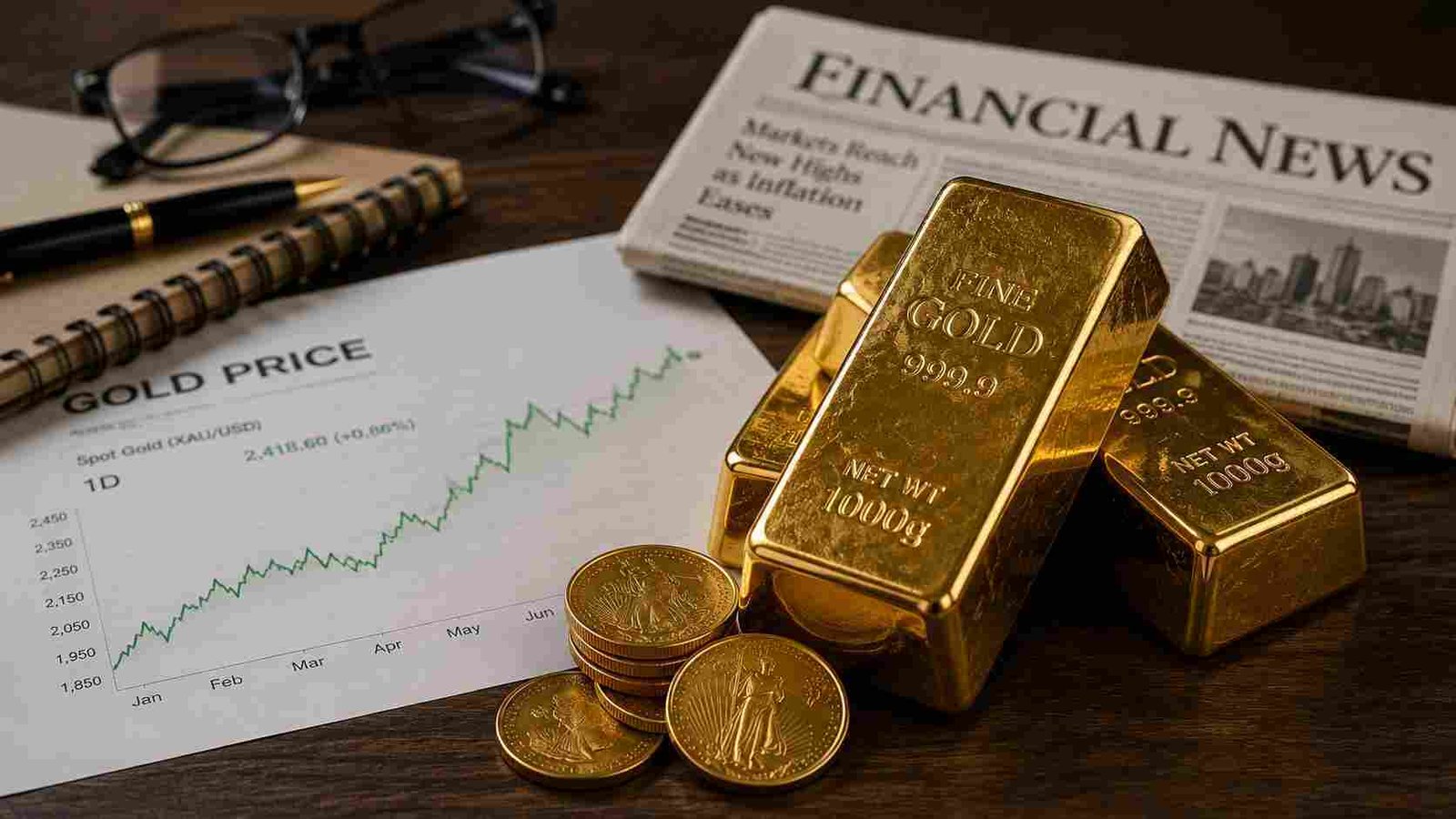
Gold Price Explained: What Actually Moves It

Gold shows up in the news almost every week. Prices rise, prices fall, and headlines rarely explain why.
If you’ve ever wondered what actually pushes the gold price up or down, you’re not alone. The reasons aren’t random, and they follow patterns that have held for decades.
This guide breaks down what moves gold, why it behaves the way it does, and what that means if you’re trying to understand it as an investor rather than just a headline reader.
What “Gold Price” Actually Means
When people say “the gold price,” they usually mean the spot price, the price to buy or sell one troy ounce of gold right now. A troy ounce is slightly heavier than a regular ounce, and it’s the standard unit used across gold markets worldwide.
Gold trades continuously across global markets, with prices influenced by activity in major hubs including London, COMEX in New York, and the Shanghai Gold Exchange.
There’s also a separate benchmark most people never hear about: the LBMA Gold Price. Twice each business day, a group of direct market participants takes part in an electronic auction in London that fixes an official reference price. Large institutional trades, jewelry contracts, and even some ETF valuations trace back to this number rather than the constantly-moving spot price.
Why the Gold Price Moves
Gold isn’t priced the way a stock is priced. There’s no company behind it, no earnings report, no CEO making promises about next quarter. Its price comes down to a handful of forces working together.
Supply and Demand
Most of the gold ever mined still exists somewhere. It doesn’t get used up like oil or wear out like other commodities, which makes its supply behave very differently from most markets.
New mining adds only a small amount to the total supply each year. Opening a new mine can take a decade or longer, so miners can’t simply ramp up production when prices rise the way other industries can.
Recycled gold, mostly from old jewelry and electronics, fills in some of the gap when prices climb high enough to make recycling worthwhile.
Demand is a bit more layered. Jewelry has historically been one of the largest sources of gold demand worldwide, and it isn’t steady through the year either, with demand often rising around wedding seasons in India and the Lunar New Year in China. Investment demand, through coins, bars, and ETFs, can overtake jewelry in periods of strong investor interest, since it swings more sharply based on economic mood. Technology and industrial use, in electronics and dentistry, is smaller than both of those, but it still adds a steady layer of demand underneath the rest.
The US Dollar
Gold is primarily quoted in US dollars in global markets, which means changes in the dollar can have a significant effect on gold prices. When the dollar weakens, gold becomes cheaper for buyers using other currencies, which tends to push demand higher. The opposite happens when the dollar strengthens.
Interest Rates
Gold doesn’t pay interest or dividends. Holding it means giving up the yield you’d earn from bonds or savings accounts instead, and that gap is what economists call the opportunity cost of holding gold.
What matters most isn’t the interest rate you see in the news. It’s the real rate, which is just that rate minus inflation, or what you actually keep after inflation eats into your return.
When that real rate is low, or even negative, cash and bonds aren’t earning much once inflation is factored in. Gold starts to look more appealing by comparison.
When real rates rise, that trade-off gets more expensive, and investors often shift toward interest-bearing assets instead.
Gold as an Inflation Hedge
Inflation is one of the most talked-about gold drivers. The idea is simple: as prices rise and money loses purchasing power, gold tends to hold its value better than cash over time. This relationship isn’t as clean as it sounds, though.
In the early 1980s, gold fell sharply even while inflation was still historically high, because interest rates rose so much that real yields turned positive, pulling money away from gold and into bonds instead.
So inflation alone doesn’t guarantee a higher gold price. It’s really the combination of inflation and interest rates that matters, which is why long-term investors watch both together rather than inflation on its own.
Gold vs Other Ways to Hedge Inflation
Gold isn’t the only asset investors reach for during inflation, and it’s worth knowing how it compares.
Treasury Inflation-Protected Securities, or TIPS, are government bonds that grow along with inflation, so the amount you get back rises as prices rise. They’re more predictable than gold, but they only cover US inflation, and their price can still drop if interest rates move against them.
Real estate has also held its value well during inflationary periods. But it’s much harder to sell quickly, and it comes with upkeep costs and mortgage complications gold simply doesn’t have.
Stocks, especially companies that can raise their own prices, can outpace inflation too. The trade-off is that stocks carry company risk and market risk that gold doesn’t.
What sets gold apart is that it doesn’t rely on a government’s promise, a company’s earnings, or a landlord finding tenants. That independence is exactly why it keeps showing up in diversified portfolios alongside these other hedges rather than instead of them.
Central Banks and Gold
Central banks are some of the largest gold buyers in the world. Countries hold gold as part of their reserves, alongside currencies like the dollar and euro, as a way to diversify away from any single currency.
In recent years, several emerging-market central banks have steadily added to their gold reserves, often citing a desire to reduce dependence on the US dollar. This isn’t a short-term trade for them. It’s a structural shift in how they manage national reserves, built up over years rather than days.
That kind of sustained, large-volume buying behaves differently from retail demand. It can quietly shift the long-term trend in price even when nothing dramatic is happening in the headlines that week.
What “Safe-Haven Asset” Really Means
You’ll hear gold called a safe haven constantly. In practice, that means investors turn to it when they’re worried about something else, whether that’s a falling stock market, a weakening currency, or political instability. Gold doesn’t depend on any single government or economy to hold its worth, which is the whole appeal.
That said, gold doesn’t always rise the moment markets get shaky. During sharp, sudden crashes, investors sometimes sell everything, including gold, just to raise cash quickly. The safe-haven effect tends to show up more clearly over weeks and months than in the first few hours of a panic.
Gold Through Major Economic Events
Theory only goes so far. Looking at how gold actually behaved during real crises shows these forces in action.
1971: the end of the gold standard. For decades, anyone holding US dollars could technically trade them in for a fixed amount of gold. That kept gold’s price locked at basically one number, tied to the Bretton Woods system rather than set by open trading.
In August 1971, President Richard Nixon suspended that convertibility, effectively ending the mechanism that had kept the dollar tied to gold. The move helped usher in the modern era of market-based gold prices that continues today.
2008: the financial crisis. Gold’s reputation as a safe haven met a real test here. In the most acute phase of the crisis, gold actually fell alongside stocks, as investors and institutions sold whatever they could to raise cash and cover losses elsewhere. Once that initial panic passed and central banks began injecting massive stimulus into the financial system, gold entered a multi-year rally that lasted well into the following decade. The lesson from 2008 is that gold’s safe-haven role can take time to show up, especially during a liquidity crunch.
2020: the pandemic shock. This crisis played out differently. Central banks cut interest rates toward zero almost immediately and rolled out stimulus at a scale rarely seen before. With real yields falling fast and uncertainty everywhere, gold climbed to new record highs within the same year, a much quicker reaction than the drawn-out recovery after 2008.
How Everyday Investors Track and Think About Gold
Most people don’t buy physical gold bars. There are several other ways to gain exposure, each with its own trade-offs.
Coins and small bars give direct ownership but come with storage and insurance to think about. Gold-backed ETFs are easier to buy and sell but involve a small ongoing fee. Mining stocks can move even more than gold itself, since they carry company-specific risk on top of the metal’s price.
Taxes are where a lot of investors get caught off guard, and it’s worth knowing before you sell, not after. In the US, certain forms of physical gold can fall under the IRS’s collectibles rules, which can mean a long-term capital gains rate of up to 28 percent, higher than the standard rate on stocks. The exact treatment can vary depending on how the gold is held.
Gold IRAs work differently. Qualifying gold held inside an IRA follows standard IRA rules instead of the collectibles rate, though eligible bullion generally has to meet specific purity requirements and be held by an approved custodian rather than at home.
None of these options change the underlying forces driving the price itself. Understanding what moves gold is the first step; deciding how, or whether, to add it to a portfolio is a separate decision that depends on your own goals.
Frequently Asked Questions
Why does the gold price rise when the stock market falls? Investors often move money into gold during uncertainty. It’s seen as a store of value that doesn’t depend on corporate performance, which makes it attractive when stocks are under pressure.
Does gold really protect against inflation? Over long periods, gold has generally preserved purchasing power better than cash. It’s not guaranteed in every short-term window, and periods of high interest rates can offset inflation’s usual effect on price.
Who actually sets the gold price? No single entity sets it. The price comes from continuous trading across major global markets, alongside a twice-daily benchmark auction in London known as the LBMA Gold Price.
Is a higher gold price always good news for investors? Not necessarily. It depends on why the price is rising. An increase driven by economic fear can signal broader financial stress, even if it benefits gold holders directly.
Is gold priced per ounce or per gram? Both, depending on where you’re buying. Global markets primarily quote gold per troy ounce, but many local dealers, especially outside the US, also list prices per gram or per kilogram for convenience.
Is gold or silver a better inflation hedge? Gold tends to be steadier and more closely tied to central bank and safe-haven demand. Silver is more volatile and has heavier industrial use, so it often swings harder in both directions during the same events.
Final Thought
Gold’s price isn’t random, even when it feels that way. Behind every move is a mix of currency strength, real interest rates, inflation expectations, and central bank behavior, often pulling in different directions at once.
Understanding these forces won’t tell you where gold goes next. But it will help you read the headlines with more context, and a lot less guessing.
