
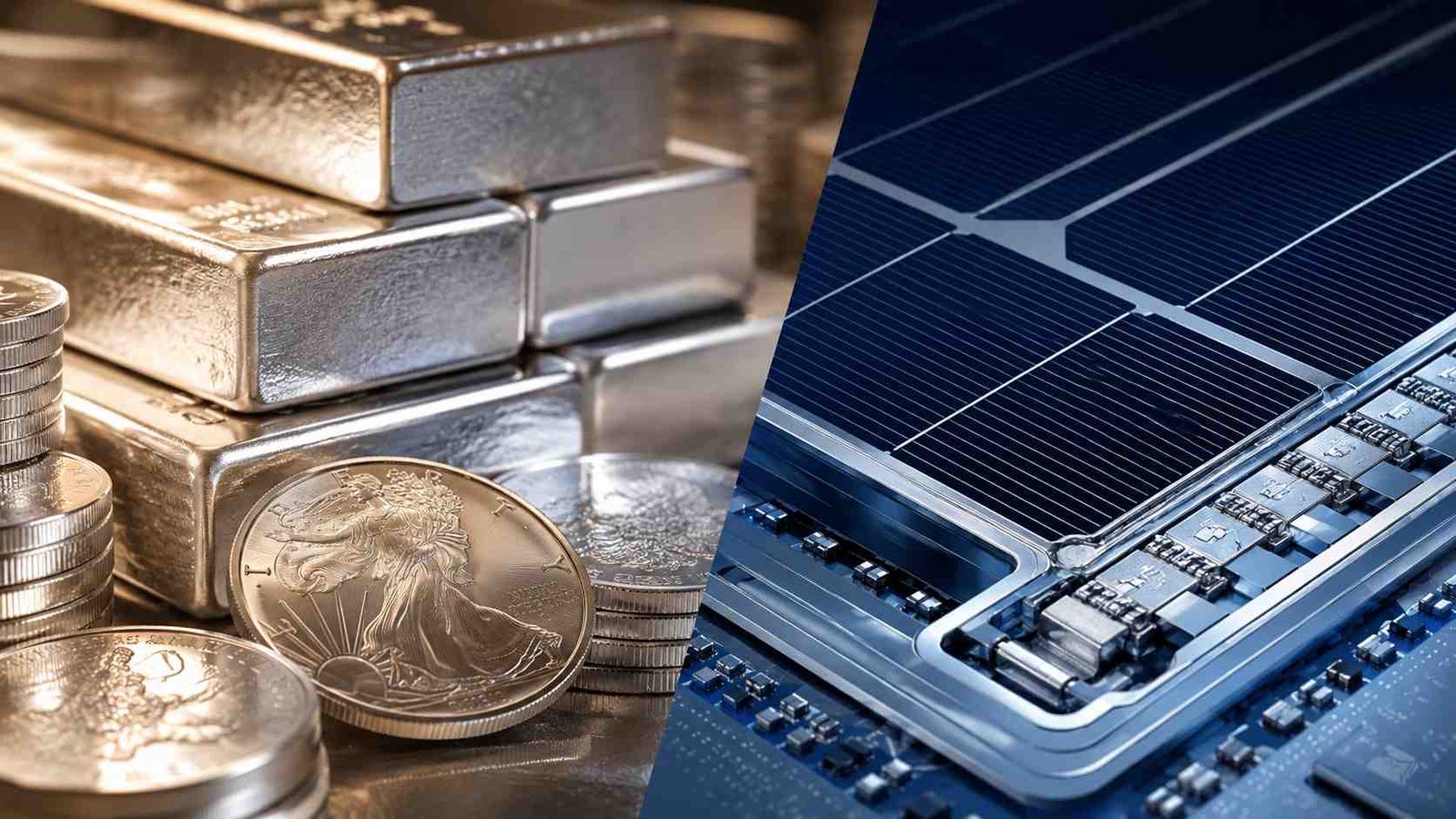
Silver Price: The Metal That Can’t Make Up Its Mind

Silver does not behave like one asset. It behaves like two.
On some days it trades like a factory input. It rises and falls with orders from electronics makers and solar panel manufacturers. On other days it trades like a safe, moving with fear, inflation worries, and the strength of the US dollar.
Most explanations of the silver price pick one of these stories and stop there. That is why silver often confuses people who already understand gold.
Gold is more closely associated with its role as a store of value and financial asset.
Silver has two jobs, and they frequently pull in opposite directions. Understanding that tension is the fastest way to understand why the silver price moves the way it does.
Two Metals in One
A large share of silver demand each year comes from industrial users rather than investors. Manufacturers buy silver because they need its properties in products and production processes.
Silver is the most electrically conductive metal and also has exceptionally high thermal conductivity. These properties make it valuable in electronics, solar technology, electrical components, and other applications where efficient conductivity matters.
Manufacturers do not buy silver because they believe in it as an asset. They buy it because their products will not work properly without it.
The investment side of silver demand looks completely different. Investors buy coins, bars, and silver-backed funds for the same reasons they buy gold. They want protection against inflation, a hedge during uncertain times, and a store of value outside the banking system.
These two buyer groups do not think alike. A factory manager buying silver for circuit boards does not care about the Federal Reserve’s next rate decision. An investor buying silver bars absolutely does.
When both groups are active at once, their motives can cancel each other out. Sometimes they reinforce each other instead. That push and pull is a large part of what makes silver harder to predict than gold.
New York, London, and the Number In Between
When people say “the silver price,” they usually mean the spot price. It reflects the current market value of silver for near-immediate delivery, while market prices change continuously as buyers and sellers trade.
COMEX in New York is one of the world’s most important venues for silver futures trading, while the London bullion market plays a major role in global physical silver trading and price benchmarking. A futures contract lets two parties agree today on a price for silver delivered at a specified date in the future.
The LBMA Silver Price is established through a daily electronic auction administered independently by ICE Benchmark Administration. The resulting benchmark is widely used across the global physical bullion trade.
Futures prices and spot prices are related but not identical. Futures prices can reflect factors such as financing and storage costs, as well as the time remaining until delivery. In practice, the two generally track each other closely.
There is also a sizing detail worth knowing. Silver is quoted by the troy ounce, not the ounce used to weigh food or mail. A troy ounce works out to about 31.1 grams, roughly ten percent heavier than a standard ounce, and that is the unit behind every spot price you will see.
Silver is also almost always priced in US dollars, no matter where in the world it trades. Gold works the same way, which is one reason the two metals get discussed together so often. Our gold price guide covers how that pricing structure works for gold, including how central bank activity shapes the number.
When Silver Acts Like a Factory Input
Industrial demand is the steadier half of silver’s story. Steady does not mean boring, though.
Electronics manufacturing has used silver for decades because of its conductivity. More recently, solar panel manufacturing has become one of silver’s largest single sources of demand. Silver paste is widely used in solar cells because of its conductivity and established performance, although manufacturers continue working to reduce the amount of silver used in each cell through thrifting and substitution.
This creates a demand base that does not care much about investor sentiment. A factory placing an order for silver paste is planning around production schedules, not headlines.
But industrial demand is not immune to shocks. In March 2020, as COVID-19 lockdowns shut down factories worldwide, silver’s price fell sharply even as gold rose.
Investors were seeking safety, which usually helps both metals. Silver’s industrial half was being dragged down by collapsing factory output at the same time.
The price fell below $12 an ounce, a level not seen in roughly a decade. What happened next showed the other side of silver’s personality.
As governments announced massive stimulus spending and interest rates fell toward zero, investment demand took over. Within about five months, silver’s price had more than doubled. The same metal that crashed on industrial fear rebounded on monetary policy, sometimes within the same year.
When Silver Acts Like a Safe-Haven Asset
Silver’s investment side responds to a fairly predictable set of triggers. Inflation fears, a weakening dollar, falling interest rates, and general uncertainty across global markets all play a role.
The interest rate connection trips people up, so it is worth explaining properly. Silver, like gold, pays no interest just for holding it.
When interest rates rise, bonds and savings accounts start paying more, which makes non-yielding assets like silver less attractive by comparison. When rates fall, that opportunity cost shrinks, and silver becomes more appealing.
A weaker US dollar has a similar effect, through a different channel. Since silver is priced in dollars, a weaker dollar makes silver cheaper for buyers using other currencies. That can pull in more international demand and push the price higher.
Sometimes this investment demand shows up in unusual ways. In January 2021, retail traders on the online forum Reddit turned their attention to silver. They had just taken part in a highly publicized retail buying surge in GameStop stock.
Some Reddit communities and posts encouraged retail investors to buy silver and silver-backed funds. The framing was that this could challenge large financial institutions. The price jumped over a short period, and buying interest overwhelmed some coin and bar dealers.
But the surge faded within days. Unlike the GameStop situation, most large traders were not betting against silver at the time. That meant there was no wave of forced buying to sustain the squeeze.
It became a case study in how investment-driven demand can move the silver price fast. It can lose momentum just as fast once the excitement passes.
The Ratio Nobody Explains Properly
The gold-silver ratio tells you how many ounces of silver it takes to buy one ounce of gold. You get it by dividing the price of gold by the price of silver.
A high ratio means silver is cheap relative to gold. A low ratio means silver is expensive relative to gold.
Investors watch this number to judge whether one metal looks undervalued next to the other. It is a comparison tool, not a guarantee of what happens next.
In several major monetary systems throughout ancient and early modern history, governments established fixed or semi-fixed gold-to-silver ratios. Rome used a ratio near 12 to 1, while the United States set the ratio at 15 to 1 under the Coinage Act of 1792.
Governments could hold it steady because gold and silver were both official forms of money, with fixed exchange rates between them. That stability ended once countries abandoned metal-backed currencies and let the ratio float freely.
Since then, it has swung across a much wider range than it ever did under official fixed rates. Silver’s industrial exposure and smaller market make its price swing harder in both directions than gold’s. That is the main reason the ratio no longer sits still the way it once did.
The One Time Silver Broke the Rules
Most of the time, silver’s price reflects the push and pull between its industrial and investment sides. In 1980, something else happened entirely.
Nelson Bunker Hunt and William Herbert Hunt were heirs to a Texas oil fortune. Through the late 1970s, they quietly accumulated physical silver. By early 1980, alongside a group of investors, their holdings represented a substantial share of the available silver supply.
They were not trading paper contracts. They were taking physical delivery and shipping bars to vaults overseas. As the available supply shrank, the price responded the way any market does when a few buyers control a large share of scarce supply.
Silver rose from around $6 an ounce in early 1979 to nearly $50 an ounce by January 1980. It was an increase most fundamentals could never justify on their own.
Exchange regulators noticed. On January 7, 1980, COMEX introduced a new rule restricting trading to liquidation only.
Traders could sell their positions but not add to them. That single rule change removed the buying pressure holding the price up.
The unwind was brutal. On March 27, 1980, now remembered as Silver Thursday, the price collapsed by roughly half in a single day. The Hunt brothers faced margin calls they could not meet.
A consortium of banks arranged an emergency credit line to stop the crisis from spreading further. The episode became an important example of the risks that commodity exchanges seek to manage through position limits, margin requirements, and other trading rules.
Silver came close to that $50 level again in April 2011. A weak dollar, aggressive monetary stimulus after the 2008 financial crisis, and growing investment demand through silver-backed funds all drove the rally.
That rally, unlike 1980, was not the product of a deliberate corner. It cooled once those same stimulus-driven conditions began to shift. Even without manipulation, silver’s smaller, thinner market can produce dramatic moves in both directions.
Why Silver Doesn’t Cost the Same Everywhere
Silver trades globally, but not everyone pays in dollars.
The international price is set in US dollars, so anyone buying with a different currency has two things moving at once. The dollar price of silver can change, and the exchange rate between their currency and the dollar can change too.
Sometimes those two effects pull in the same direction. Sometimes they cancel out instead. A buyer in a country with a weakening currency can see silver get more expensive in local terms even if the dollar price barely moves.
This is also why the same ounce of silver rarely costs exactly the same amount at two different dealers, even within one country. Local premiums, shipping, import costs, and taxes where they apply all sit on top of the underlying spot price. The international number is the reference point, not the final price tag.
What People Get Wrong About the Silver Price
A few myths follow silver around no matter how often they get corrected.
The first is that the spot price is what you pay for a physical coin or bar. It is not.
Dealers add a premium on top of spot to cover minting, distribution, and their own margin. The price tag at a coin shop will always sit above the live spot number.
The second is that silver always moves in lockstep with gold. The two are correlated, meaning they often move in the same direction.
But silver’s industrial demand gives it a separate set of triggers gold does not have. That is exactly why the price can diverge sharply during a factory slowdown or a solar demand surge.
The third is the idea that silver’s price is fully controlled by large banks. Regulatory scrutiny of silver trading has increased since 1980, specifically because of episodes like the Hunt corner. Modern exchange rules exist to prevent a repeat.
That does not mean the market is perfectly efficient. But a fixed price set by a handful of banks is a myth, not a mechanism.
Frequently Asked Questions
Why does the silver price move more than the gold price? Silver’s market is smaller than gold’s, and its industrial demand adds a second set of triggers gold does not have. Both factors combine to make its price swing harder in both directions.
Is silver a good hedge against inflation? Silver has historically attracted investment demand during periods of high inflation, similar to gold. Its industrial exposure means it does not always behave as a pure inflation hedge, since a slowing economy can offset the effect even during inflationary periods.
What is the difference between the silver spot price and the silver futures price? The spot price is for immediate delivery. The futures price is for delivery at a set date in the future, and it factors in storage costs and prevailing interest rates until that date.
Why is the price I pay for silver coins higher than the spot price? Dealers add a premium to cover minting, distribution, and their margin. This premium changes based on demand and available supply, separate from the underlying spot price.
Does silver have a larger industrial demand share than gold? Yes. Industrial applications account for a much larger share of silver demand than gold demand. Silver is widely used in electronics, solar technology, electrical components, and other industrial applications, while gold’s demand is more heavily concentrated in jewelry, investment, and central bank holdings.
What was silver’s all-time high price? Silver’s two most famous historical spikes came in the 1980 Hunt brothers episode and the April 2011 rally, when prices approached the $50 per ounce mark before pulling back sharply. More recent years have brought new records as well.
How is the daily silver price actually set? Silver prices change continuously through global trading, including futures markets such as COMEX, alongside the LBMA Silver Price, a daily benchmark for silver delivered in London.
Is the silver price the same everywhere in the world? No. The international price is set in US dollars, so local currency movements can change what silver costs in another country even when the dollar price stays flat. Dealer premiums, shipping, and local taxes add further differences.
How many grams are in a troy ounce of silver? A troy ounce equals approximately 31.1 grams, heavier than the standard ounce used for everyday items. Silver is quoted by the troy ounce in international markets.
The Bigger Picture
Silver’s price will keep telling two stories at once. One is written by factories. The other is written by investors.
Most of the confusion around silver comes from trying to explain its price with only one of those stories. Once you see both sides working at the same time, the swings start to make a lot more sense.
